

Wallpaper for the Washingtons: Adelphi's restoration project at Mount Vernon

Over the past decade, Adelphi Paper Hangings has reproduced eight sidewall papers and eleven borders for George and Martha Washington’s home Mount Vernon, located just outside Washington, D.C.
One of the last rooms to be renovated was the Washingtons’ Bedchamber. Although it is known primarily as the room where Washington died, its significance extends far beyond that. Constructed as part of the Mansion’s south wing addition in the mid-1770s, the room evolved over the decades into a centre of family life, domestic management, and daily work. It was connected to adjoining storage spaces and the back stairway, forming a private suite where Martha Washington oversaw key aspects of the household.
As was the case for almost all spaces at Mount Vernon, little physical documentation existed for the room. Those fragments of wallpaper which were discovered were thought to be from a later redecoration of the room. However, documentary evidence suggests that George Washington took measurements for new wallpaper and furnishings in 1796-97.


Therefore, as part of the 2025 renovation of the Bedchamber, the curators at Mount Vernon selected a mid-1790s arabesque pattern from the French firm of Réveillon, Jacquemart et Bénard to be recreated by Adelphi. The Philadelphia stationer William Poyntell had been an agent for this company’s patterns in the US and it was also a company from which George Washington made purchases, so it was a plausible and period-appropriate choice.

The arabesque and two accompanying borders were originally installed at the Emerson Homestead in Old York, Maine around 1794–1795. The pattern, inspired by the classical Roman frescoes found at sites such as Pompeii and Herculaneum, features a pair of love birds, appropriate for a bedchamber. We were exceedingly fortunate that the many historic full-repeat fragments were in remarkably good condition. Of course, the highly saturated colouring was diminished but all the necessary design elements were intact, a crucial aspect for pattern drafting.

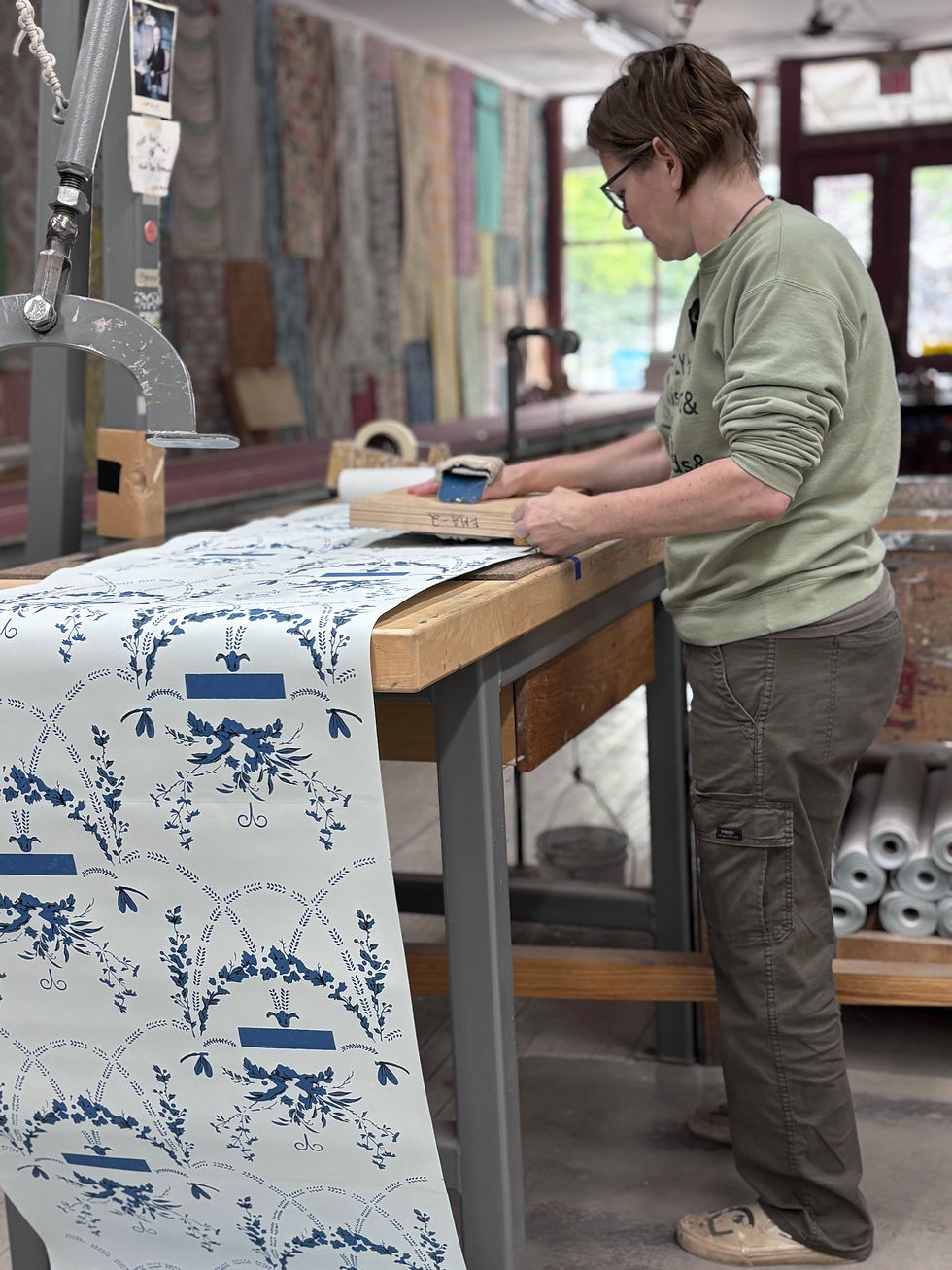
When we initially reviewed the Emerson paper there appeared to be four printed colours on a ground: orange and blue printed with the primary blocks plus red and black, with those blocks printing the fine details. However, a closer examination seemed to suggest that the red and black were actually printed with the same block. Where the paint was printed over the orange it showed as red; on the blue it appeared black. One possible explanation is that the chemicals in the pigments of this detail paint reacted differently to the colour underneath. The detail colour on the blue was decidedly black, not simply a very dark red.
Since our paint bases and pigments are modern and, therefore relatively stable, they did not behave in the same way as the originals. As a result, we separated the red and black printing elements and remounted them on separate blocks.

As one final project for Mount Vernon is being considered by the curators, it is worth reflecting on the ultimate purpose behind the redecoration campaign.
Aside from our first project for the mansion, Washington’s New Room Border, none of the subsequent papers were actually discovered there. However, the existing log books indicate that Washington purchased paper hangings for many of the rooms. With this in mind, the curators felt that, in order to give the general public a sense of the domestic atmosphere of the time, period-appropriate wallpaper was required.


At Monticello, Thomas Jefferson’s home, a different philosophy is in place. There too, there are records of copious amounts of wallpaper installed; as with Mount Vernon, none of it survived. Without any historic documentation to refer to, save for one room, it was decided to leave the walls blank, rather than make conjectures.
Both approaches are valid, though we – not being entirely objective – gravitate toward the former.
Steve Larson, Adelphi Paper Hangings


