

WHS visits Surface Print to see multiple types of wallpaper printing
Seeing wallpaper coming to life through the printing process is always exciting for WHS members and the recent visit to Surface Print in Clayton-Le-Moors in Lancashire was no exception. WHS members arrived from around the country and beyond to gather at the factory where we were given a fascinating tour by Print Manager Paul Phillips.

Paul explained that the history of the company dated back to 1990, but that the current Managing Director John Watson was the third generation of wallpaper makers in his family. John had been Managing Director at Crown before leaving to set up on his own. Surface Print now employs 68 staff at its extensive works, printing largely for major brands such as Romo, Osborne & Little and Cole & Son and producing papers under its own brand of 1838 – named after the date when the roller printer was invented.

Surface Print uses an impressive variety of printing machines, from sturdy cast-iron surface printers dating back 140 years to state-of the-art HP digital printers (essentially mammoth versions of office printers). Most printing is onto non-woven substrates, where artificial fibres are blended into wood pulp, but a handful of clients still request traditional wood-pulp papers. The modern non-woven coverings are designed to be hung onto a ready-pasted wall which arguably makes life easier for the home decorator but does not necessarily appeal to the professional.

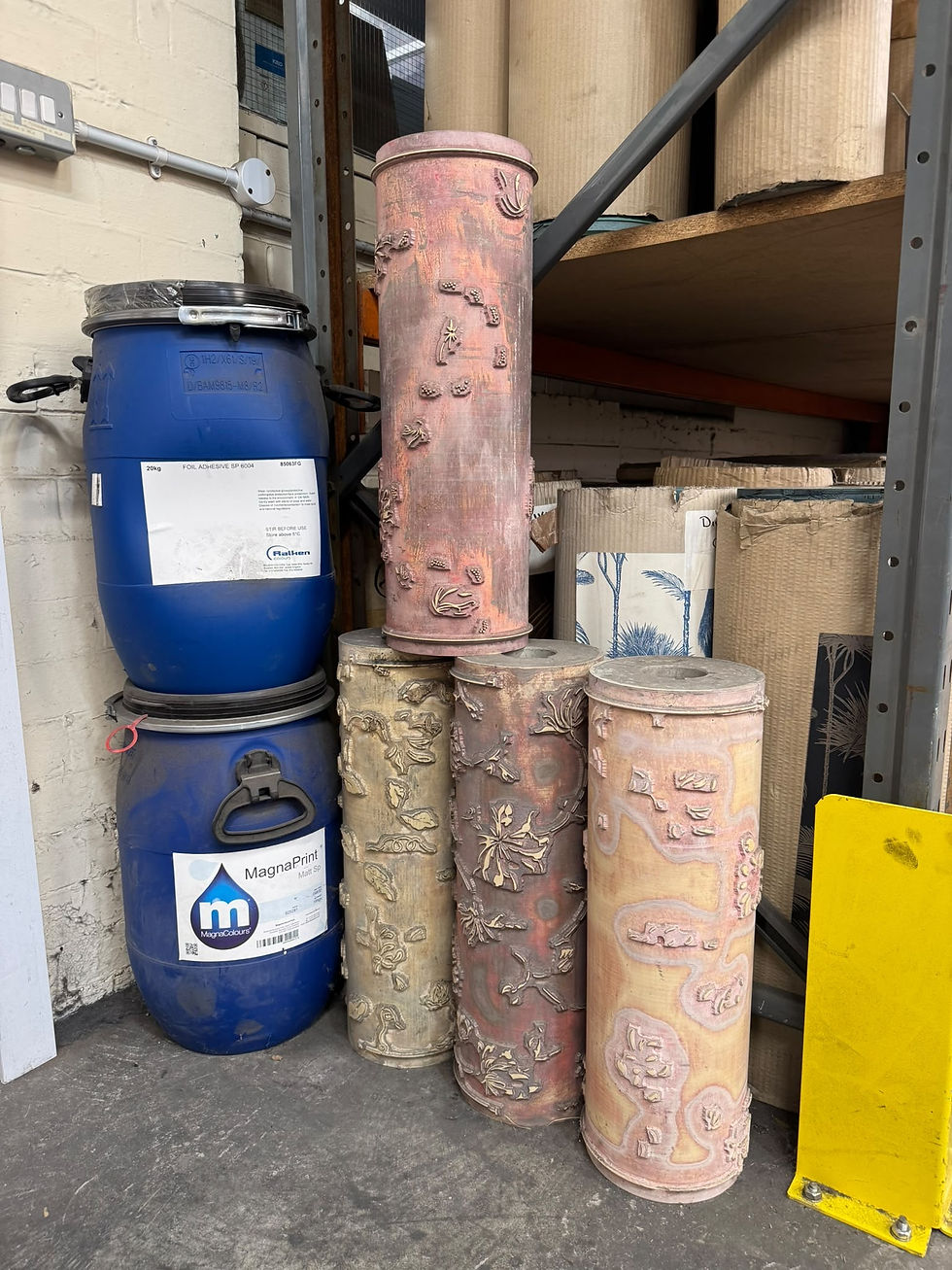
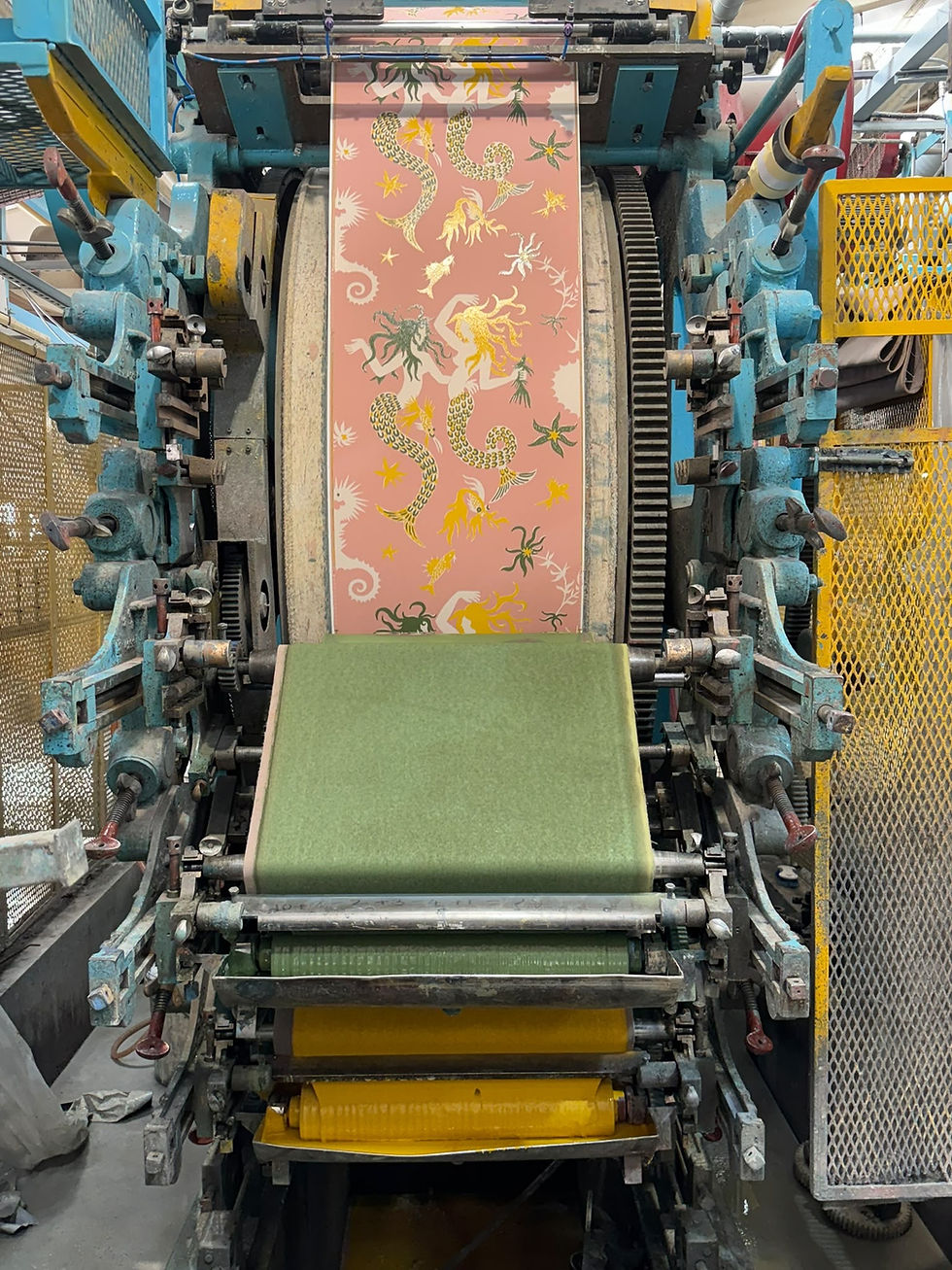
The surface print technique was essentially adopted from the calico-printing industry and pioneered by Potters of Darwen. It is best suited to opaque colours and large-scale designs such as florals where it offers a painted look and emulates as closely as possible a hand-blocked appearance. The factory also prints using flexo rollers where a rubber coating bearing a design is applied to a roller. Ceramic rollers with a honeycomb structure pick up the ink and pass it on to the design roller, with up to six print trays being used in one process. This method uses less ink, is twice as fast as surface printing and provides the light touch and fine detail needed, for example, in toile prints.
Digital printing provides very different benefits. Although it is slow, the set-up costs are minimal and it is incredibly flexible, allowing for different widths and textures of paper, varieties of scale and a minimum of one roll. This makes it very appealing for experimental work and TV and film orders. Recent commissions include a Bayeux tapestry facsimile on paper! The printers can run all through the night without supervision, backed up by an alarm system to alert staff at home if problems arise.

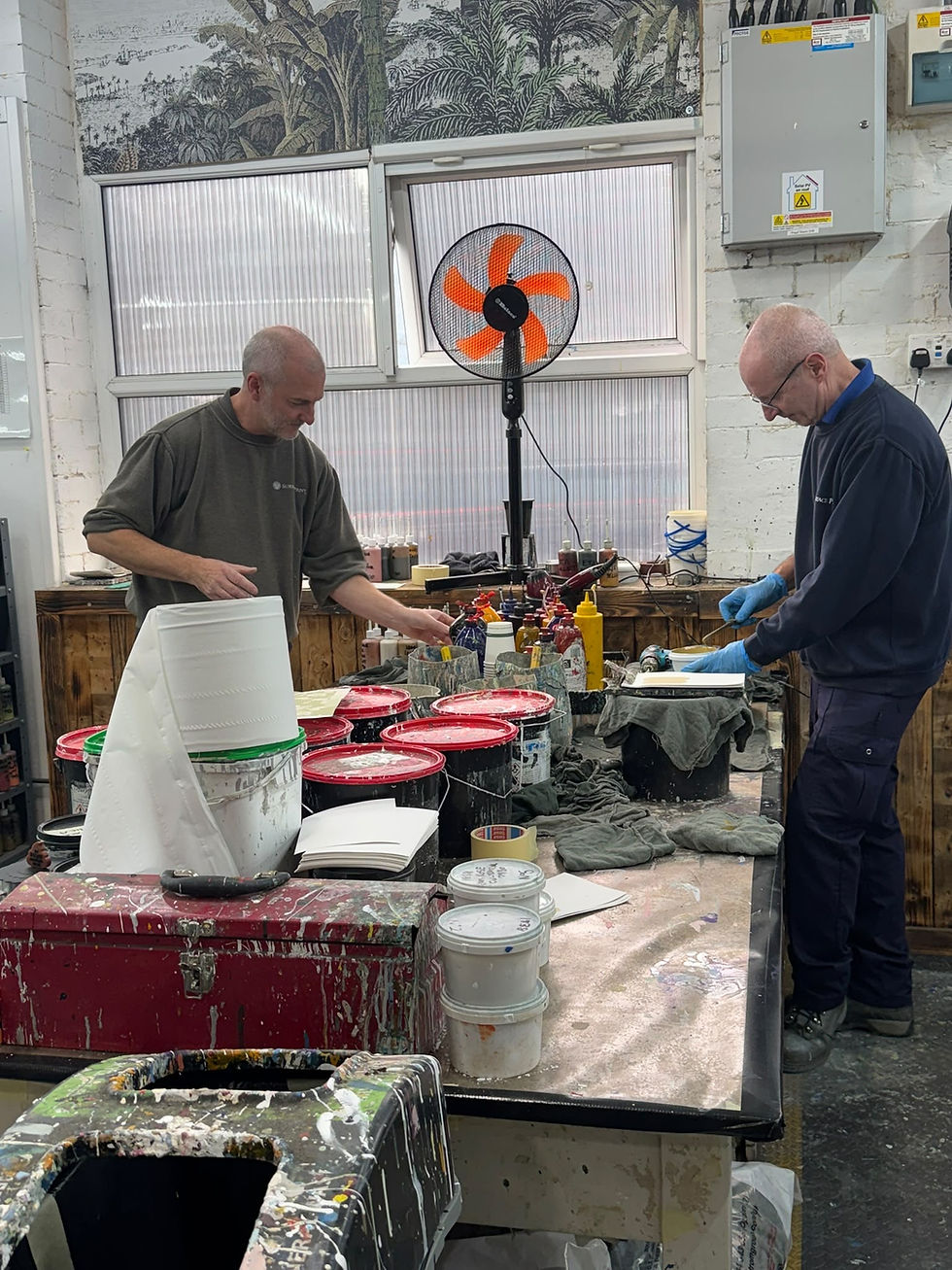
Alongside all these inspiring examples of mechanisation, it was intriguing to visit the colour mixing area where skilled employees allowed us to watch while they judged original designs and gradually experimented with blending colours by eye until they achieved exactly what was needed.

Although we were all already in awe of what the company was capable of, there was one more treat to come – the flock printer. Historically flock paper was printed by carved wooden blocks dipped into paste with the paper then being passed through a flocking box where small fibres of wool or silk would adhere to the pasted pattern. It was costly and highly labour intensive. Now, the flock papers are surface printed and passed mechanically on the roll through a sealed box full of nylon fibres which are drawn down onto the pattern using static electricity. The effects are stunning.
The visit to Surface Print proved so interesting and informative that we stayed long beyond our allotted time and had to race to our next destination of Gawthorpe Hall. Look out for a separate write-up of that very different but equally absorbing encounter with wallpaper.
Our heartfelt thanks go to Paul and all the team at Surface Print who welcomed us so warmly and were so generous with their time.
Lucy Ellis
All photos by Caroline Bennett Jane


