

WHS Visit to Sanderson Design Group Archive
Updated: Mar 18
Such was the popularity of this event that tickets sold out within an hour of release, so it was a treat for members to view the archives at the Sanderson Design Group's headquarters at Voysey House, Chiswick, in London.
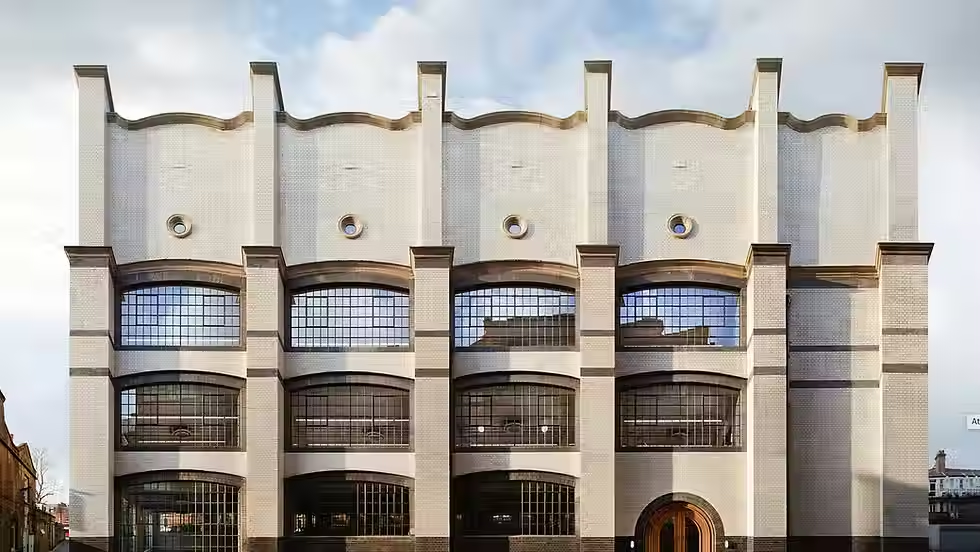
We were welcomed by Assistant Archivist Dr Emma Hardy, who started by explaining the history of the building. Voysey House was built in 1902 as part of an expansion of the Sanderson wallpaper factory to meet growing consumer demand and is the only commercial building designed by the celebrated Arts & Crafts architect and designer C.F.A. Voysey.
Sadly, a fire in 1928 destroyed the Sanderson works, although the Voysey building remained. Some logbook records still show evidence of fire damage. In 2024, after an extensive and sympathetic restoration, Sanderson Design Group moved its Head Office from Denham back to Voysey House. It accommodates a spacious showroom on the ground floor with office space above and the archive is located on the porthole-lit third floor. The Sanderson Archive contains over 70,000 documents and prior to the move the items were photographed to digitise the collection. Emma explained the next step will be to catalogue the collection, which is quite an onerous task.
Sanderson 1893 factory and advertisement from 1900 © Sanderson Design Group
Arthur Sanderson founded the firm in 1860 as an importer of French wallpapers. The company would go from modest beginnings to develop into one of the leading manufacturers of decorative products, famous not just for its wallpapers but also textiles and paint.
Emma had laid out a number of archive documents to show us, starting with a Zuber & Cie of Rixheim c1860s hand-block-printed wallpaper. The colours were just as glorious as if it had been printed yesterday. Another French company that Sanderson imported from was Paul Balin. Their speciality was wallpapers with the three-dimensionality of textiles and stamped leather. They imitated Cordovan leather and historic textiles and one paper we were shown was inspired by a seventeenth-century Persian silk satin with metal thread embroidery, a fabric of great subtlety.
The imitation leather papers were made from block-printed paper that was painted, gilded, embossed and varnished. Some were initially imported from Japan and were similar to the French versions, and we were shown fine examples of these from Rottman & Co.
We also viewed ‘The Rossetti’ with its accompanying frieze, originally designed in 1885. This was surface-wash printed by machine at the Chiswick factory in 1897. This is a process in which the ground pigment is sieved to create an overall finish. The pattern’s name alludes to Dante Gabriel Rossetti and the circle of William Morris. Morris himself had sought to produce such translucent tints but never achieved them.


Sanderson took over several prestigious long-established wallpaper and paint companies in the first quarter of the twentieth century. These included Charles Knowles, Casson & Co., Heffer Scott & Co., William Woollams and Essex & Co., along with Jeffrey & Co., who printed designs by Walter Crane, Owen Jones, Heywood Sumner and William Morris. By 1940 they had bought Morris & Co. after it went into voluntary liquidation. We were shown a variety of papers by these designers, some of which are still in production today, such as William Morris’s ‘Daisy’ of 1864 and ‘Pimpernel’ of 1876, Morris & Co.’s current top-selling design, along with the designs shown below.


Various other papers were brought out, in particular Anglo-Japanese designs of 1888 which were block-printed at Chiswick and designed for use on stairways. The decorator could cut them in half lengthwise, forming panels that could be moved up each stair riser. A number of Sanderson advertisements, along with some nursery designs, added a touch of nostalgia for a bygone era. Sanderson has continuously held a Royal Warrant since 1924 and we were able to see an image of George VI (when he was Duke of York) visiting the factory. The archive holds numerous logbooks recording production dates and designs and we were shown a Sanderson logbook and one of the Morris & Co. logbooks, which were orginally kept by Jeffrey & Co. The old black and white photographs of Sanderson staff sports days showed the community spirit at the works.
Whilst our visit was primarily to look at wallpapers, we also got to see Kenneth Truman’s original fabric design for ‘Sorilla’, one of Sanderson’s most loved and recognisable patterns. A renowned botanical artist, Kenneth Truman joined the Sanderson studio in 1939, and although he retired in 1969, he continued to work part-time until his death in 1977. The reputation of Sanderson for English floral designs is based entirely on Truman’s output and some of his designs still remain in the range today.

Many memories were stirred during this visit that sparked stories, conversations and connections with the designs we were shown, with some WHS members having worked for Sanderson throughout its long hstory. It was wondeful to see how well the historic documents are cared for but it is also a working archive that still provides a source of inspiration to the Sanderson design team as they bring out new interpretations of these designs for the modern world.
Our thanks go to Dr Emma Hardy and Charlotte Rickards of Sanderson Design Group for their hospitality and for hosting the two groups across the afternoon.
Caroline Bennett-Jane
All photos by the author unless otherwise stated


